Article Review of Notes of the Underground by Herbert
Taking Upward a Claiming: Wolf past Herbert J. Stern and Alan A. Winter
WRITTEN Past MYFANWY Cook
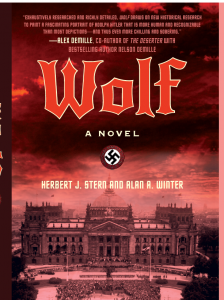 In writing their novel Wolf (Skyhorse, 2020), Herbert J. Stern and Alan A. Winter were faced with two major hurdles. The beginning was maximizing and sharing their writing skills. The 2d was depicting highly controversial characters from relatively recent history.
Stern is a sometime US Attorney and United states District Court Judge, who has also served as a judge of the U.s.a. Courtroom of Berlin, while Winter combines periodontistry with novel writing. "We met over forty years agone and over fourth dimension, nosotros became friends. Every bit each of us worked on our ain books, we would share manuscripts with each other and ask for comments." Winter explains: "Eventually Herb suggested we write a book together. Herb had been doing research into Hitler's life and had uncovered information he believed was largely ignored by historians. He wanted to write a novel that would brainstorm when Hitler was hospitalized for hysterical blindness at the stop of World State of war I. Herb's idea was for a fictional character to befriend Hitler at the infirmary through whom Hitler's personal life every bit he rose to power from 1918 to 1934 would be told. We researched and wrote our novel, meeting nigh weekly for the next three years."
"It was always a collaboration in every sense of the discussion. In the stop, our research led the states to paths we hadn't known existed, simply made our story richer and more authentic."
From the get-go they identified three critical points. Firstly, they note, "We had to starting time when Hitler was blinded in a gas assail in the last days of Globe State of war I. The hospital had to exist understaffed and overflowing with patients. It was logical (to us) that Hitler would need a boyfriend patient to assistance him navigate the daily routines. So, believing such a man could exist, nosotros created our fictional character, Friedrich, who forged a bond with Hitler. Equally a grapheme, Friedrich was strengthened by having amnesia … a tabula rasa. Every bit such, he allowed us to follow all that happened to Hitler in those early on years from the time the Nazi Party was formed until the twenty-four hour period he became dictator of Germany."
Secondly, considering they wanted to be as authentic as possible, they realized that the story had to be chronological. Thirdly, they explain, "because we knew the direction the story had to take, we did not stop to outline it or even write a synopsis of where information technology would atomic number 82. We had history equally our template."
When researching, they "did not automatically have footnotes," but they "verified them by going to original sources." As research progressed, the authors say, "We ran into difficulties when the original sources were in German language. Since neither of us read German language, we hired a translator, Alan Wallis. This proved invaluable." They also found primary sources in interviews by the noted historian, John Westward. Toland and in post-WWII interviews conducted by Michael Musmanno, who they authors say "sought out everyone he could detect who had worked directly with Hitler."
Before commencing writing, they hadn't envisaged any major obstruction to co-writing a novel. Ane thing they hadn't anticipated: "Our notions of an historical novel were different. Our writing styles are different, and nosotros had differences of stance about how much exposition should be office of the story."
They addressed this challenge for historical graphic symbol by, they note, "using their original words. We described their physicality as best nosotros could. Nosotros did not requite them attributes they didn't accept or take abroad those they did accept. We are peculiarly proud that when we needed a new grapheme to help motility the story forwards, we didn't merely make one up out of convenience but searched the historical record for persons from that same place and time who would raise our story. Aside from Bernhard Weiss, two other notable characters were portrayed in the book as they were in real life: Kitty Schmidt, who ran the nigh famous bordello in Berlin, and Lilian Harvey, who was not only Federal republic of germany's favourite motion-picture show star, merely all of Europe'southward. Both will reprise their roles in the next volume, as will the Jewish gangster, Longie Zwillman, who was very real."
They discovered, the authors annotation, "that Hitler went to great lengths to conceal his mental illness and the fact that he preyed on teenaged girls. Not but did he succeed in erecting a drape that shielded the German people from these aspects of his life, but historians, to this very day, take failed to lift that curtain to reveal what was behind information technology. We felt it was time to tear downwards that curtain."
They suggest that readers might "look at biographies of Hitler and see if there is mention of him existence in a mental ward at the end of the Great War. Some might become so far equally to say he had been exposed to a gas attack and was temporarily blinded, but they stop there. None mention the doctor who treated Hitler. Certainly, there is no mention of an eye doctor in whatsoever biography treating Hitler. Nor do any mention that a psychiatrist treated him."ane
Winter points out, "Two men did find out: Professor Rudolph Binion of Tufts and John W. Toland. Both made their discoveries and worked together in the early on 1970s. Rather than tell these truths, most Hitler biographers accept been content to repeat Hitler's own clarification of his blindness as reported in his autobiography, Mein Kampf. A careful reading of Hitler'due south ain words reveal that his blindness was mental, non organic. We felt strongly that rather than conscience history, it should be presented it happened."
The authors believe that "another reason for exploring this catamenia in Hitler'due south life was that he has been described in various ways equally a subhuman, un-human, asocial, a black hole, incapable of having a friend or being in a meaningful relationship. Nothing could be further from the truth. We wrote Wolf to make certain that the world would know that the embodiment of evil can exist wrapped in a human being who loves women, is loyal to his friends, and is admired by many."
References:
ane. http://www.notesonwolf.com | Stern and Winter'due south 115 pages of historical notes explaining what they have uncovered.
ABOUT THE Contributor: MYFANWY COOK is a prize-winning short fiction author. She is likewise HNR New Voices Editor and author of Historical Fiction Writing: A Practical Guide and Tool-kit and Creative Writing Cocktails.
Published in Historical Novels Review | Result 92 (May 2020)
pelletiercondets61.blogspot.com
Source: https://historicalnovelsociety.org/taking-up-a-challenge-wolf-by-herbert-j-stern-and-alan-a-winter/
0 Response to "Article Review of Notes of the Underground by Herbert"
Post a Comment