what is something useful man to buy 2017
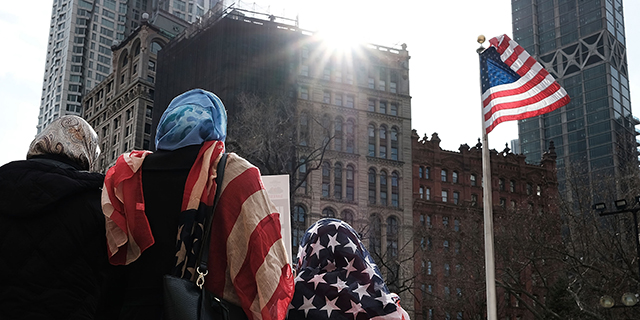
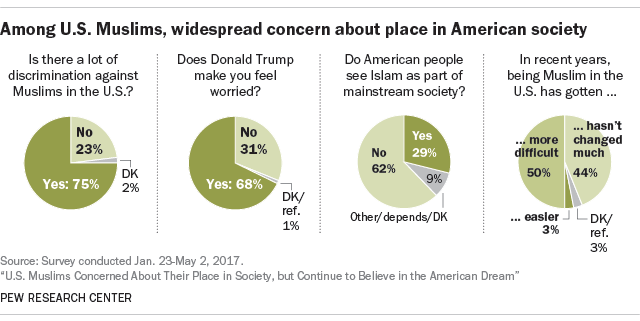
The early days of Donald Trump's presidency have been an anxious time for many Muslim Americans, according to a new Pew Inquiry Center survey. Overall, Muslims in the United States perceive a lot of bigotry confronting their religious grouping, are leery of Trump and think their beau Americans do non run into Islam as function of mainstream U.Due south. society.
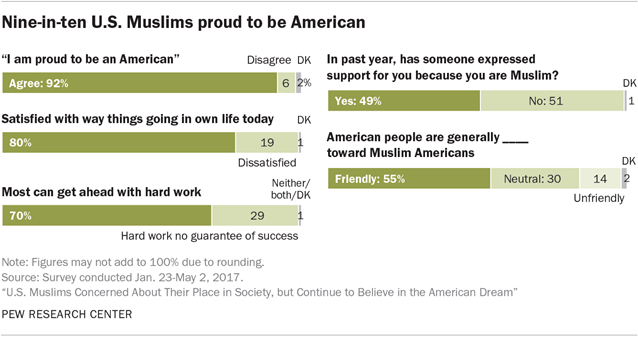
At the same time, withal, Muslim Americans express a persistent streak of optimism and positive feelings. Overwhelmingly, they say they are proud to be Americans, believe that hard work generally brings success in this land and are satisfied with the way things are going in their own lives – even if they are non satisfied with the direction of the land equally a whole.
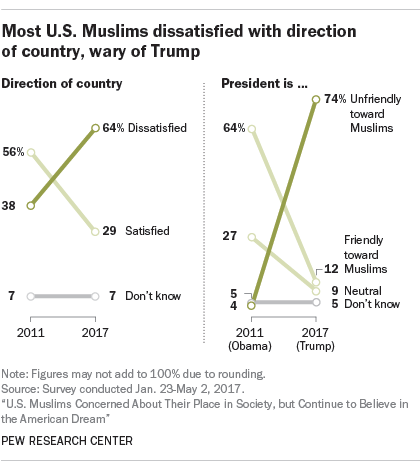 Indeed, about two-thirds of Muslim Americans say they are dissatisfied with the style things are going in the U.S. today. And most three-quarters say Donald Trump is unfriendly toward Muslims in America. On both of these counts, Muslim opinion has undergone a stark reversal since 2011, when Barack Obama was president, at which point most Muslims thought the country was headed in the correct direction and viewed the president as friendly toward them.
In addition, half of Muslim Americans say it has become harder to exist Muslim in the U.Southward. in recent years. And 48% say they have experienced at least one incident of discrimination in the by 12 months.
Simply alongside these reports of discrimination, a similar – and growing – share (49%) of Muslim Americans say someone has expressed support for them because of their religion in the past year. And 55% retrieve Americans in general are friendly toward U.S. Muslims, compared with just 14% who say they are unfriendly.
Despite the concerns and perceived challenges they confront, 89% of Muslims say they are both proud to be American and proud to exist Muslim. Fully eight-in-ten say they are satisfied with the mode things are going in their lives. And a big majority of U.South. Muslims continue to profess faith in the American dream, with 70% saying that most people who want to get ahead can make information technology in America if they are willing to work hard.
These are among the primal findings of Pew Research Heart'south new survey of U.S. Muslims, conducted January. 23 to May 2, 2017, on landlines and cellphones, among a representative sample of 1,001 Muslim adults living in the United states. This is the third time Pew Research Center has conducted a comprehensive survey of U.Southward. Muslims. The Heart's initial survey of Muslim Americans was conducted in 2007; the 2nd survey took place in 2011.
The new survey asked U.S. Muslims nearly a wide diverseness of topics, including religious beliefs and practices, social values, views on extremism and political preferences. While the survey finds that a majority disapprove of the style Trump is handling his job, this is not the first fourth dimension the community has looked askance at a Republican in the White Firm. Indeed, Muslim Americans are no more disapproving of Trump today than they were of George W. Bush-league's performance in office during his second term a decade agone.
And while Muslims say they face a variety of challenges and obstacles in the U.S., this too is nothing new. The share of U.S. Muslims who say information technology is getting harder to be a Muslim in America has hovered effectually 50% over the past 10 years. Over the aforementioned period, half or more of Muslims have consistently said that U.S. media coverage of Muslims is unfair.
The Muslim population in the U.S. is growing and highly diverse, fabricated up largely of immigrants and the children of immigrants from all beyond the globe. Indeed, respondents in the survey hail from at least 75 nations – although the vast bulk are now U.S. citizens. As a grouping, Muslims are younger and more racially various than the general population.
Muslims also are quite varied in their religious allegiances and observances. Slightly more than half of U.Southward. Muslims are Sunnis (55%), but significant minorities place as Shiite (16%) or as "just Muslim" (14%). Most Muslims say faith is very of import in their lives (65%), and well-nigh four-in-10 (42%) say they pray five times a day. Only many others say organized religion is less important to them and that they are not then consistent in performing salah, the ritual prayers that found one of the Five Pillars of Islam and traditionally are performed five times each day.
The survey besides shows that Muslims largely share the general public'southward concerns most religious extremism. Indeed, if anything, Muslims may be more concerned than non-Muslims nigh extremism in the proper name of Islam. Still nearly Muslims say there is little support for extremism within the U.South. Muslim community, and few say they think violence confronting civilians tin can exist justified in pursuit of religious, political or social causes.
Muslims concerned nigh extremism, both globally and in U.Due south.
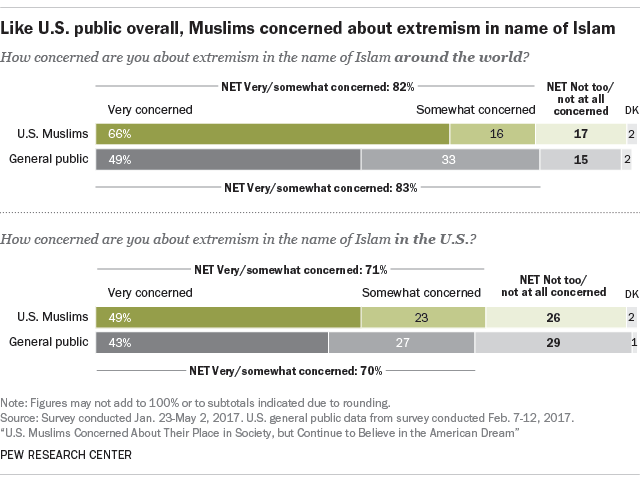
Overall, eight-in-ten Muslims (82%) say they are either very concerned (66%) or somewhat concerned (xvi%) about extremism in the name of Islam around the earth. This is similar to the pct of the U.South. general public that shares these concerns (83%), although Muslims are more than likely than U.Southward. adults overall to say they are very concerned nearly extremism in the name of Islam around the earth (66% vs. 49%).
Well-nigh seven-in-x Muslims – and a similar share of Americans overall – are concerned virtually extremism in the name of Islam in the U.South., including roughly one-half of U.S. Muslims (49%) who say they are very concerned nigh domestic extremism.
Amidst both Muslims and the larger U.S. public, business organization about extremism around the earth is higher now than it was in 2011 (see Chapter five for details on trends over time).
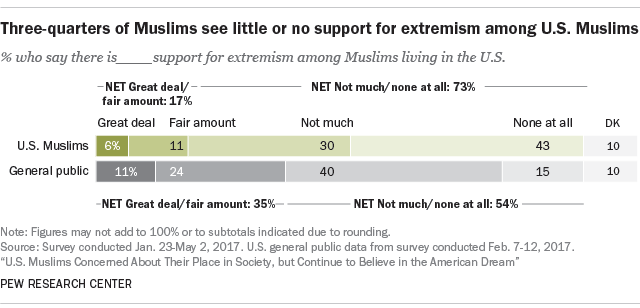
While concern about extremism has risen, at that place is little change in perceptions of how much support for extremism exists amidst Muslims in the United States. About three-quarters of U.S. Muslims (73%) say in that location is picayune or no back up for extremism among American Muslims, while nigh one-in-6 say there is either a "fair amount" (11%) or a "great bargain" (6%) of support for extremism within the U.Southward. Muslim community.
The overall American public is more divided on this question. While 54% of U.S. adults say at that place is little or no back up for extremism among Muslim Americans, roughly a third (35%) say in that location is at least a "fair amount" of backing for extremism among U.S. Muslims, including eleven% who think there is a "smashing deal." (For more data almost how the U.South. public views Muslims and Islam, come across Affiliate vii.)
When is killing civilians seen as justifiable?
To meliorate understand what some people had in mind when answering this question most targeting and killing civilians for political, social or religious reasons, Pew Research Center staff called dorsum a small number of respondents and conducted non-scientific follow-up interviews. Many respondents – both Muslims and non-Muslims – who said violence against civilians tin can sometimes or oft be justified said they had in heed situations other than terrorism, such as armed forces activeness or self-defense. For more than details on this question, see Chapter 5.
When asked whether targeting and killing civilians tin can be justified to farther a political, social or religious cause, 84% of U.Southward. Muslims say such tactics tin rarely (eight%) or never (76%) be justified, while 12% say such violence tin sometimes (7%) or ofttimes (5%) exist justified.
This question was designed to be asked of the general public as well. Compared with the U.Southward. public as a whole, Muslims are more likely to say targeting and killing civilians for political, social or religious reasons is never justifiable (76% vs. 59%). Roughly equal shares of Muslims (5%) and Americans as a whole (3%) say such tactics are often justified (the difference between these numbers is non statistically significant).1 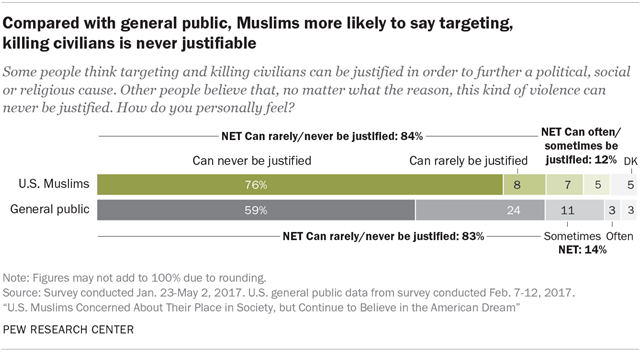
While U.S. Muslims are concerned about extremism and overwhelmingly opposed to the apply of violence against civilians, they also are somewhat mistrustful of law enforcement officials and skeptical of the integrity of regime sting operations. About four-in-ten U.S. Muslims (39%) believe most Muslims who have been arrested in the U.S. on suspicion of plotting terrorist acts posed a real threat. But three-in-ten (30%) say law enforcement officers take arrested mostly people who were tricked and did not pose a real threat. And an boosted three-in-10 volunteer that "it depends" or offer another response or no response. Views on this topic amidst the general public are less divided: A bulk of U.Due south. adults (62%) say officers in sting operations take mostly arrested people who posed a existent threat to others.
Meanwhile, about a third of Muslim Americans say they are either very worried (fifteen%) or somewhat worried (20%) that the government monitors their phone calls and emails because of their religion. Withal, on a unlike question – which does not mention religion – Muslims actually are less probable than Americans overall to think the government is monitoring them: Virtually six-in-ten Muslims (59%) say information technology is either very probable or somewhat likely that the authorities monitors their communications, compared with 70% of the general public.
Roughly one-half of Muslims say they have experienced recent discrimination
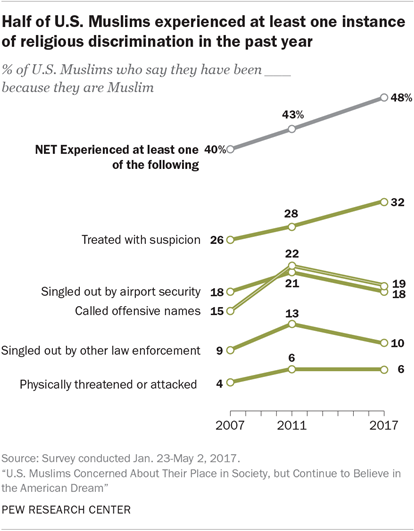 In addition to gauging broad concerns about discrimination, the survey also asked Muslims whether they personally have experienced a few specific kinds of discrimination within the past year. The share of U.S. Muslims who say they have faced at least one of these types of bigotry has risen modestly in recent years.
Almost a third of Muslims, for example, say they have been treated with suspicion over the past 12 months because of their religion. Nearly one-in-five say they have been called offensive names or singled out past airport security, while 1-in-x say they have been singled out past other constabulary enforcement officials. And half-dozen% say they have even been physically threatened or attacked.
In total, near half of Muslims (48%) say they have experienced at least one of these types of discrimination over the by year, which is upward slightly from 2011 (43%) and 2007 (xl%). In addition, nearly i-in-five U.South. Muslims (18%) say they have seen anti-Muslim graffiti in their local community in the terminal 12 months.
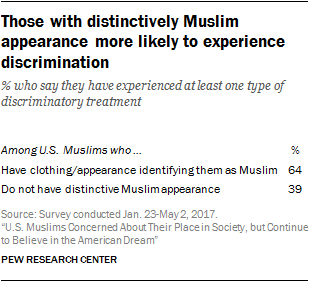 Experiences with discriminatory treatment are specially common amid those whose appearance identifies them as Muslim. Overall, near four-in-ten Muslims (38%) – including half of Muslim women (49%) – say that on a typical 24-hour interval, at that place is something distinctive most their appearance, voice or clothing that people might associate with Muslims. Of those whose appearance is identifiably Muslim, nearly two-thirds (64%) say they have experienced at least one of the specific types of discrimination asked most in the survey. Among Muslims who say they do not have a distinctively Muslim appearance, fewer study these types of experiences (39%).
While roughly half of Muslims say they have experienced a specific instance of discrimination over the past year, a like share (49%) say someone has expressed back up for them because they are Muslim in the past 12 months. The percentage of U.Southward. Muslims who study this blazon of experience is upwardly significantly since 2011 (37%) and 2007 (32%).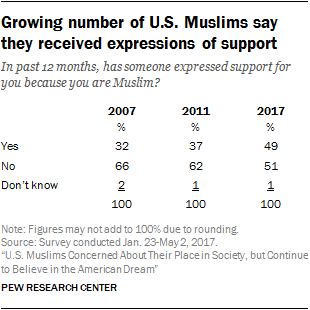
In their own words: What Muslims said most discrimination and support
Pew Research Eye staff chosen back some of the Muslim American respondents in this survey to get additional thoughts on some of the topics covered. Here is a sampling of what they said near their experiences with discrimination and the expressions of support they have received:
"I have definitely experienced both [bigotry and support]. I've had people make comments and of course they'll give me weird looks and things like that. But I've definitely heard people [make] rude comments straight to my confront. I've also had people say actually nice things near my hijab, or say it's beautiful or say they call up my faith is beautiful." – Muslim adult female under 30
"In that location was a fourth dimension where I used to wear a veil that covered my face, the niqab, and I take public transportation, and when I was on a coach someone claimed I was a terrorist. I did not know what to do because no one always called me that. The person was sitting most me, and I recollect getting off the motorbus. No one came to my defence and I did not expect anyone to come to my defence force. If you cover your face, people assume you are unsafe. I don't article of clothing the niqab anymore. … I heard a woman took a bus and she wore niqab and got attacked. People were worried for my rubber, and I did non want to have a chance. I vesture the hijab [covering the hair, but non face up] at present. This happened a year agone and after that I stopped wearing a niqab. Now, I get questions a lot, but people are non afraid. [When wearing the niqab], people assumed I was not built-in here and don't speak English. Even wearing hijab I get that. Only with hijab, in that location is curiosity simply not discrimination." – Muslim woman under 30
"I accept lived in this country for 15 years and have never had a bad feel because of my faith or faith." – Muslim adult female over 60
"I have never experienced discrimination in a direct or targeted mode. Things have been very good. Merely sometimes I see someone looking at me funny because of my emphasis and the way I look, and it makes me a little uncomfortable. But I have a lot of support. Everyone I piece of work with supports me, then I accept many people who tin can help." – Muslim human being nether 30
"I accept a lot of friends, and simply customs members, who are very open – who are glad to have this kind of diversity in their customs, where there aren't a lot of Muslims at all. I'g probably the only Muslim they know or they'll always know. And they're glad for that, and they like to give support and exist in that location." – Muslim man nether 30
"Occasionally [my daughter] would say kids make fun of her. Or the kids would inquire, 'Are you bald under hijab?' 'Why don't you show your pilus?' … [While attention a parade], a couple from [the South] engaged my daughter, and my wife was sitting on one demote and my other girl and I were sitting on some other. And she started request her, 'Does your dad brand you vesture this?' And my daughter was prepared to reply and said, 'Nope. This is my selection. He supports me. It'south not required. My mom doesn't wear information technology. Just I wear it because I cull to wearable it.' I think those types of experiences are something she goes through, and I remember we basically reassure her every time that we go an opportunity: 'This is what yous've called to do. Now you take chosen to express yourself, and we stand by you 100%. This is America and everyone is gratuitous to choose to live the mode they cull.'" – Muslim father
Muslims leery of Trump
 The human relationship between Donald Trump and the U.S. Muslim community has received a lot of media coverage, especially following Trump'south statement during the campaign that he would seek a "total and complete shutdown of Muslims inbound the United States" and his executive order blocking travel from six Muslim-bulk countries. 2
About three-quarters of Muslim Americans (74%) say the nation's new chief executive is unfriendly toward their group, while two-thirds (65%) say they disapprove of the way Trump is handling his job as president. U.S. Muslim stance on the sitting president has turned dramatically since 2011, when Muslims expressed much more positive views of Barack Obama.
In 2007, nigh the end of his 2d term, George W. Bush received approving ratings from U.Due south. Muslims that were almost as depression as Trump's today. Respondents in that survey were non asked whether they thought Bush was friendly toward Muslim Americans.
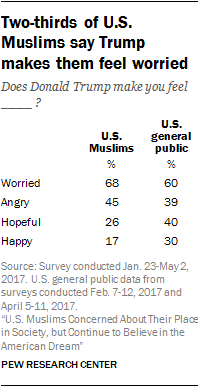 In the new survey, respondents were asked whether Trump makes them feel four emotions – two positive (hope and happiness) and two negative (worry and anger). Fully two-thirds of Muslim Americans (68%) say the president makes them feel worried, and 45% say he makes them experience aroused. Far fewer say the president makes them feel hopeful (26%) or happy (17%).
Muslim Americans are less likely than the public as a whole to say Trump makes them feel hopeful (26% vs. xl%) or happy (17% vs. 30%), but about as likely to say Trump makes them experience worried or angry.
Muslims proud to be American, but say they face significant challenges in U.Southward. society
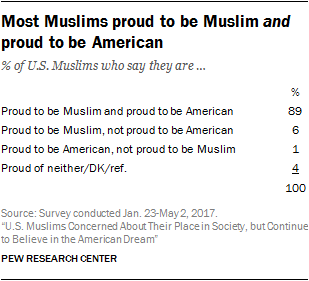 U.S. Muslims express pride in their religious and national identities alike. Fully 97% agree with the statement, "I am proud to be Muslim." About as many (92%) say they concur with the statement, "I am proud to be an American." In full, 89% agree with both statements, saying they are proud to be Muslim and proud to be American. Just half-dozen% say they are proud to exist Muslim and not proud to be American, and 1% say they are proud to be American and not proud to exist Muslim.
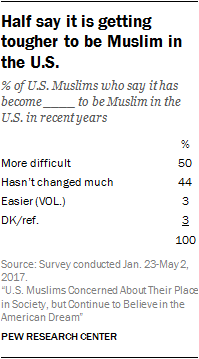 At the same time, many Muslims say they face a variety of significant challenges in making their mode in American society. Fully one-half say that it has go more than hard to be Muslim in the U.Due south. in recent years, and an additional 44% say the difficulty or ease of being Muslim has not changed very much. Just 3% volunteer that it has become easier to be Muslim in America.
Muslims who say information technology has become more difficult to be Muslim in the U.S. in recent years were asked to describe, in their ain words, the main reasons for this. The nigh common responses include statements about Muslim extremists in other countries, misconceptions and stereotyping virtually Islam among the U.S. public, and Trump's attitudes and policies toward Muslims. (For full details, see here.)
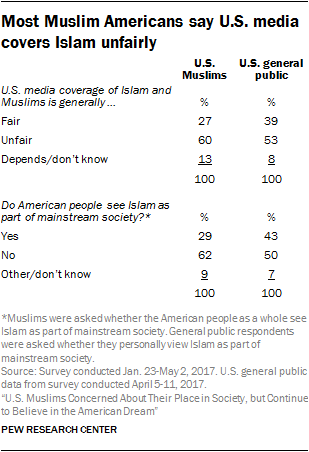 Most Muslims (60%) also perceive media coverage of Muslims and Islam as unfair, and a like share (62%) remember the American people as a whole practise not see Islam as part of mainstream American social club. These views are largely echoed by U.South. adults overall, many of whom agree that media coverage of Muslims is unfair and say they personally do not encounter Islam every bit part of mainstream society.
But tension is not the only thing that defines the relationship between Muslims and the rest of the U.Due south. population. Six-in-ten U.Due south. Muslims say they have a lot in common with most Americans. And Muslims are much more likely to say the American people, in general, are friendly toward Muslims in the country (55%) than to view Americans as a whole equally unfriendly (14%). (Three-in-10 say Americans are mostly neutral toward Muslims.) Moreover, U.S. Muslims have become slightly more than probable to view the American public as friendly toward them since 2011, when 48% took this position.
Muslim women more concerned than men almost their place in society
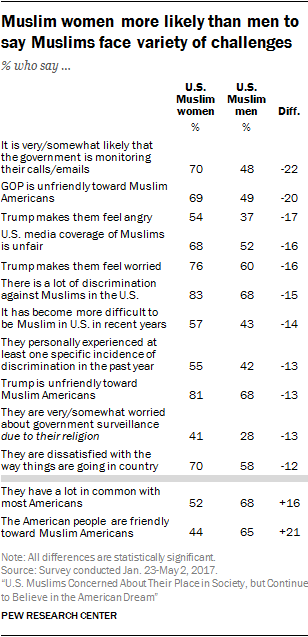 The survey finds a consequent gender gap on several questions about what it is like to be a Muslim in America, showing that Muslim women accept a higher level of concern than Muslim men nigh the place of Muslims in U.S. gild.
For case, more than Muslim women than men say that there is a lot of discrimination against Muslims in the U.S. today, that they have personally experienced discrimination and that it has get more hard to exist Muslim in the U.S. in recent years.
In addition, more Muslim women than men say Donald Trump makes them aroused or worried, and more women than men say both Trump and the Republican Party are unfriendly toward Muslim Americans.
Muslim women are more than likely than Muslim men to say that they are dissatisfied with the way things are going in the country and that media coverage of Muslims is unfair. Meanwhile, more than Muslim men than women say that they accept a lot in mutual with near Americans and that the American people in full general are friendly toward Muslim Americans.
In their ain words: What Muslims said about their place in America
Pew Enquiry Center staff chosen back some of the Muslim American respondents in this survey to become additional thoughts on some of the topics covered. Here is a sampling of what they said about what it is like to be a Muslim in the United States in 2017:
"One of the things I noticed as I was going through this [survey] process … as a result of things [such as] … Muslims spying on our own population, electronic monitoring, the Muslim lists, I noticed I was actually self-censoring. I was very nervous about providing the feedback initially. … Information technology's one of those underlying subliminal things that but happens. Because you feel like y'all're in a constant land of nervousness. … It's something that is prevalent across the community." – Immigrant Muslim man
"I don't really feel like I have a lot in mutual with well-nigh Americans. It depends on their upbringing, their race, everything like that. I think that we take a lot of dissimilar ideals, and we believe a lot of different things. … So I do experience a lot different, a sense of not plumbing equipment in as much." – Muslim woman under 30
"What I have in common with most Americans is a dedication to this country. We also have in common our shared humanity. … We're all struggling to earn, pay our taxes and raise our kids. More and more, I'one thousand finding it hard to observe mutual ground with people who don't empathize minority communities. The minorities are condign the majority, and I know that'south hard for some people. I experience sympathy for them; empathy as well. But they demand to accept this new reality." – Muslim adult female in her 40s
"In that location is so much attention drawn to people existence Muslim and symbols of Islam, hijab being 1 of them. We have to have extra caution scanning our surroundings – know where nosotros are, who is around and what kind of thoughts they might hold for Islam, about Islam or against Islam. Specially when the Muslim ban was introduced the first time around, I literally felt similar the persecution had started. Because nosotros had read the history of Europe and what happened to the Jewish people in Federal republic of germany. These footling steps lead to bigger bug later on. And so, we really felt similar we were threatened. And, fortunately, the justice system stopped implementation. And after on people stopped talking most information technology, and after a while it seemed similar things might exist getting improve." – Immigrant Muslim man
"I run into some immigrants – and not simply Muslims, they could be Latinos besides – who don't adapt well to their new country and don't want to be part of American social club. They stick with others like themselves because they're agape and feel strange here. But that's non me. I am completely American, and I experience at abode hither. When I first came here, I went to high school and that helped me to become more than fully American and to suit to the culture. I experience like I accept a lot in common with the people I see and know here, and I feel completely comfortable here. When you go far in America as an immigrant, yous have to let your by go, or else you won't exist able to become a part of your new country." – Muslim homo under 30
"I'd say it'due south been increasingly difficult, really. You about get that post-9/11 atmosphere in the United States considering of the suppression, really, of minorities and minorities' thoughts and voices. People like the alt-right or ultraconservative Trump supporters now accept a larger voice that was suppressed only years ago, and now they're really allowed to make heard what they think about Muslims and minorities in general. And so it's a lot of tensions have been rise and fears that we're going backward." – Muslim man under xxx
Muslim demographics: A various and young population
Muslims represent a relatively small but rapidly growing portion of the U.S. religious landscape. Pew Research Eye estimates that there are 3.45 one thousand thousand Muslims of all ages living in the U.S. – upward from virtually ii.75 million in 2011 and ii.35 million in 2007. This means Muslims currently brand upwardly roughly 1.1% of the U.South. population. iii (For more than information about how many Muslims live in the U.Southward. and almost how Pew Research Centre calculates these figures, come across Chapter 1.)
Muslim Americans are largely an immigrant population: Roughly six-in-ten U.Southward. Muslims ages 18 and over (58%) were born outside the U.S., with origins spread throughout the world. The well-nigh common region of origin for Muslim immigrants is South asia, where one-in-five U.South. Muslims were built-in, including 9% who were born in Islamic republic of pakistan. An additional 13% of U.South. Muslims were born elsewhere in the Asia-Pacific region (including Iran), 14% in the Middle East or Due north Africa, and 5% in sub-Saharan Africa.
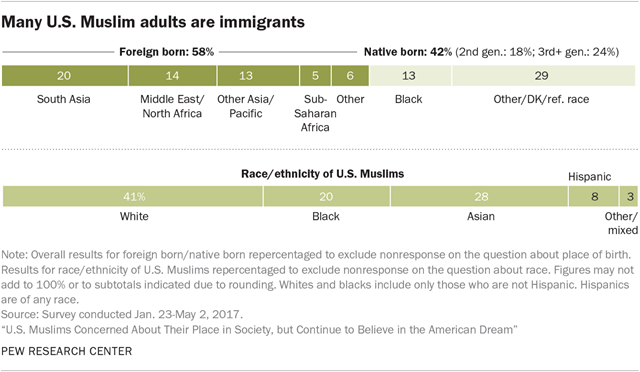
Due in no small part to their broad range of geographic origins, U.S. Muslims are a racially and ethnically diverse population. No single racial grouping forms a majority, with about four-in-ten Muslim adults (41%) identifying as white (including Arabs and people of Middle Eastern ancestry), 28% identifying as Asian (including people of Pakistani or Indian descent) and one-in-five identifying equally black or African American.
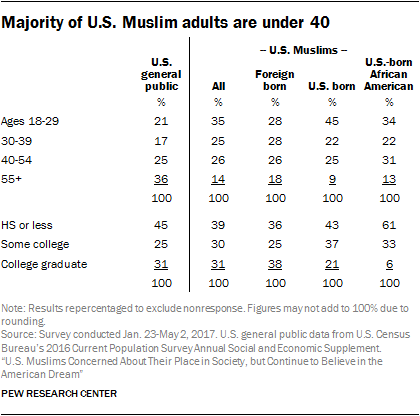 The data as well show that Muslim Americans are a very immature group. Most Muslim adults (60%) are nether the historic period of xl. Past comparison, just 38% of the U.S. adult population as a whole is younger than xl.
Three-in-ten Muslims (31%) are higher graduates, which is on par with the share of U.S. adults as a whole who take completed college. But Muslim immigrants are, on average, more highly educated than both U.S.-built-in Muslims and the U.Southward. public every bit a whole. (For more on the demographics of the U.Due south. Muslim population, see Chapter 1.)
Muslims say their organized religion is not only about beliefs and rituals
The diversity of Muslims in the U.South. extends to religious beliefs and practices as well. While nearly all Muslims say they are proud to be Muslim, they are not of one listen nigh what is essential to being Muslim, and their levels of religious practice vary widely.
Almost U.S. Muslims (64%) say in that location is more than one true way to interpret Islam. They also are more likely to say traditional understandings of Islam need to exist reinterpreted in lite of mod contexts (52%) than to say traditional understandings are all that is needed (38%).
Muslims as well were asked whether each of 8 actions and behaviors is an "essential" part of what being Muslim ways to them, an "important but not essential" role or "not an important" role. Fully 85% of Muslims say assertive in God is essential to what being Muslim ways to them, more than than say the same about any other detail in the survey. And nearly three-quarters say "loving the Prophet Muhammad" is essential to what being Muslim means to them.
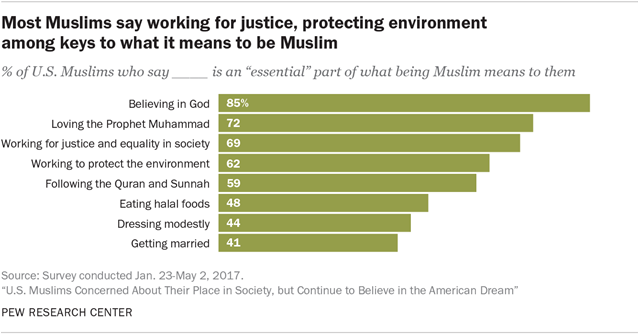
Yet many U.S. Muslims say that for them, personally, being Muslim is almost more these core religious beliefs. Roughly seven-in-ten, for case, say "working for justice and equality in society" is an essential part of their Muslim identity, and 62% say the same about "working to protect the environment" – which is higher than the share of U.S. Christians who said protecting the surround is essential to their Christian identity in response to a similar question (22%).
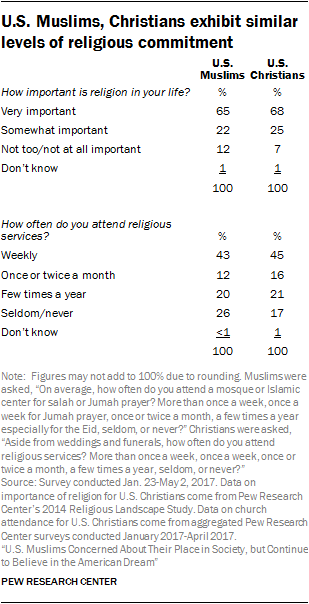 In other means, though, U.S. Muslims await similar to U.Due south. Christians – on average, the two groups show roughly equal levels of religious commitment. About two-thirds of U.S. Muslims (65%), for instance, say religion is very important in their lives, as practice 68% of Christians, according to Pew Research Center's 2014 Religious Landscape Study. And 43% of Muslim Americans say they attend a mosque on a weekly basis, on par with the 45% of U.S. Christians who take described themselves as weekly churchgoers in recent surveys. Some other 12% of U.Due south. Muslims say they go to a mosque monthly, and one-in-five (xx%) say they get to a mosque a few times a year, peculiarly for important Muslim holidays such as Eids.4 (For more than data on Eid and other terms, see the glossary.)
The survey as well shows that eight-in-ten Muslim Americans say they fast during the Islamic holy month of Ramadan. And roughly iv-in-ten Muslims (42%) say they pray all five salah daily, with another 17% saying they make some of the five salah each day. (Salah is a form of ritual prayer or observance performed throughout the twenty-four hour period, and praying salah is i of the V Pillars of Islam. For more information, see the glossary.)
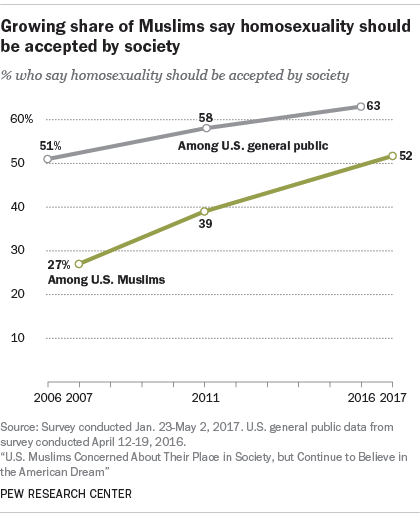 American Muslims, like the U.S. public as a whole, have become much more accepting of homosexuality in recent years. In the first Pew Research Heart survey of Muslims, in 2007, far more than Muslims said homosexuality should be discouraged past society (61%) than said information technology should exist accepted (27%). Past 2011, Muslims were roughly evenly split on this question. Today, Muslims who say homosexuality should exist accepted by society conspicuously outnumber those who say it should be discouraged (52% vs. 33%).
While Muslims remain somewhat more conservative than the general public on views toward homosexuality, they are more ideologically liberal than U.Southward. adults overall when information technology comes to immigration and the size of government. Most eight-in-ten U.Southward. Muslims believe that immigrants strengthen the country with their hard work and talent (79%), which is perhaps not surprising, given that nearly Muslims are themselves immigrants. And 2-thirds of Muslim Americans (67%) say they adopt a larger government that provides more services over a smaller government that provides fewer services.
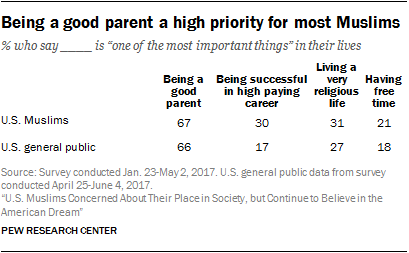 On another issues, the views of U.Southward. Muslims mirror those of the larger public. Like Americans overall, nearly Muslims rank being a good parent as "1 of the most important things" in their lives, and they tend to rate having a successful career and living a very religious life as at least somewhat of import just not necessarily among the most important things in life.
Political preferences: Muslims are strongly Democratic
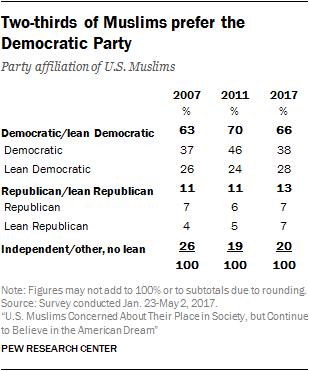 Two-thirds of U.Southward. Muslims either identify equally Democrats or lean toward the Democratic Political party; far fewer (13%) place as Republican or lean toward the GOP. Muslims favored the Democratic Political party over the GOP past comparable margins in both previous Pew Enquiry Center surveys.
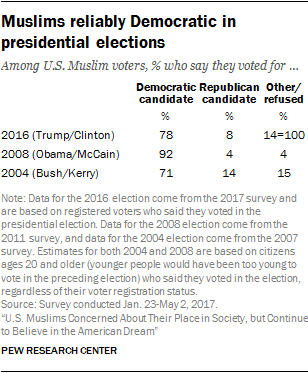 When asked how they voted in concluding year's presidential election, iii-quarters of Muslim voters (78%) say they backed Hillary Clinton, 8% say they voted for Trump, and 14% say they voted for some other candidate or decline to say how they voted. Clinton'southward lxx-point margin of victory over Trump among Muslims falls short of Barack Obama's margin over John McCain; in the 2011 survey, 92% of U.S. Muslim voters said they cast ballots for Obama in 2008, compared with just 4% who reported voting for McCain. In 2007, 71% of U.S. Muslims said they voted for John Kerry in 2004, compared with 14% who voted for George W. Bush.
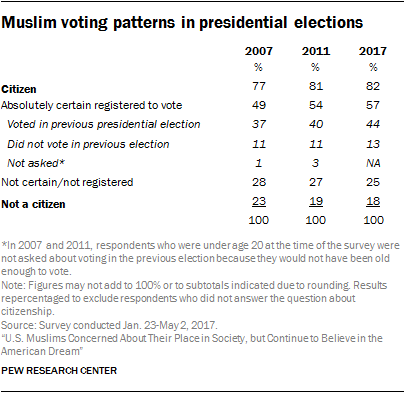 Overall, 44% of U.S. Muslims say they voted in the 2016 ballot.5 About one-in-five Muslim adults living in the U.South. (18%) are not U.S. citizens, and thus not eligible to vote. In addition, one-in-four Muslims are citizens only are non registered to vote (25%), and 13% of Muslims are registered voters who stayed domicile on Election Day.half-dozen
Two-thirds of Muslims (65%) say they do not call up in that location is a natural disharmonize between the teachings of Islam and democracy, while iii-in-ten say there is an inherent conflict between Islam and commonwealth.
Those who say there is a conflict were asked to explain, in their ain words, why they think Islam and democracy clash. Some say that Islam and democracy accept fundamentally incompatible principles and values (40% of those who say there is a disharmonize), others say the apparent disharmonize is considering non-Muslims don't sympathize Islam or considering terrorists give Islam a bad name (xvi%), and all the same others say democracy is incompatible with all faith (9%). (For more details on responses to these questions, see Affiliate iv.)
pelletiercondets61.blogspot.com
Source: https://www.pewresearch.org/religion/2017/07/26/findings-from-pew-research-centers-2017-survey-of-us-muslims/
0 Response to "what is something useful man to buy 2017"
Post a Comment